(1)(1).jpg)
RAMADAN WAS DIFFERENT IN THE ASR AL-SA‘ADAH…
Fasting was known in the Meccan period. The Prophet Muhammad (peace be upon him) and some of the Sahaba (companions of the Prophet Muhammad) would fast as a mustahabb (recommended or encouraged but not obligatory) act, in a manner whose exact form we do not know.
When the Prophet Muhammad arrived in Medina, he learned that the Jews fasted on the Day of Ashura to commemorate the deliverance of the Prophet Musa (Moses) from Pharaoh, so he fasted on that day and instructed Muslims to do the same. Later, when fasting in Ramadan became obligatory, fasting on Ashura became optional. Previously, there was no getting up at night for suhur (pre-dawn meal). Iftar (fast breaking) would be done when the stars appeared. Even if the fast was broken, being with one’s spouse was forbidden. Islam abolished these practices.
.jpg)
Half of Patience
The obligation of the Ramadan fast was instituted 18 months after the Hijrah, in the last days of the month of Sha‘ban. The Battle of Badr took place immediately after this, during the month of Ramadan whose beginning coincided with 26 February 624. Since the verse of the Qur’an permitting those on a journey to postpone their fast had not yet been revealed, the Muslims fought while fasting.
Accordingly, the Prophet Muhammad fasted the month of Ramadan nine times. He described fasting in winter as “booty obtained without hardship,” and said, “Fasting is half of patience, and it is the zakat (purification) of the body.”
The month of Ramadan would begin with the sighting of the crescent; if the crescent was not seen, the month of Sha‘ban would be completed as thirty days. The Prophet Muhammad would recommend hastening the iftar and delaying the suhur, in opposition to the Ahl al-Kitab (the People of the Book) who delayed iftar until the stars appeared. Indeed, he would break his fast with a single date or a sip of water, then perform the prayer.
From the hadith of Aisha bint Abu Bakr, which reports that one should hasten both the evening prayer and the iftar, it is understood that performing the evening prayer does not prevent making iftar early. Indeed, Caliph Umar and Uthman would perform the evening prayer as soon as its time entered, and then break their fast after the prayer.
A Sip of Water
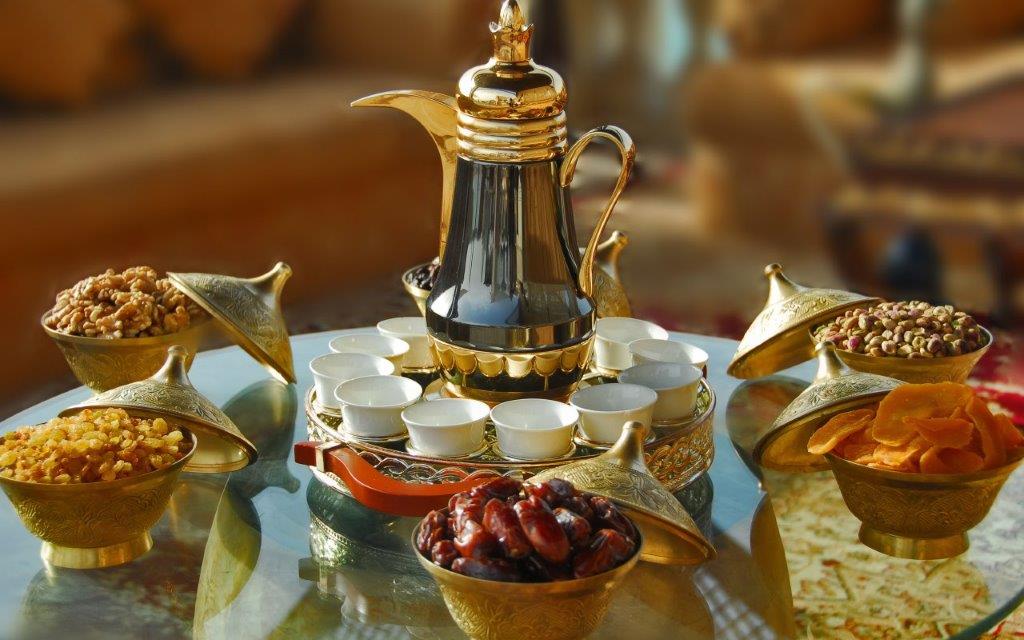
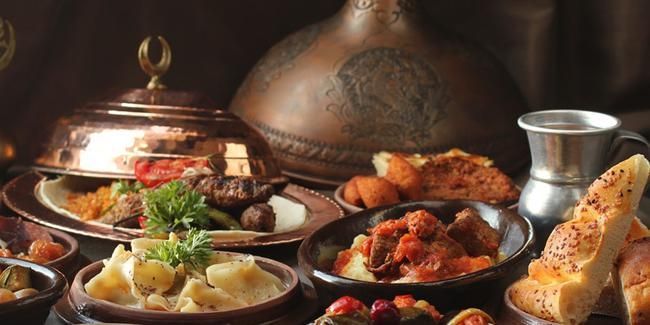
The iftar table of the Prophet Muhammad was modest. Anas ibn Malik, who served him for ten years, says that when the time entered, he would break his fast with a few fresh dates; if not, with dry dates; and if those were not available, with a few sips of water. Beginning a meal with salt has also been praised. It is also reported that he would break his fast with dates in winter and with water in summer.
Abdullah ibn Abi Aufa narrates that the Prophet Muhammad would have prepared for iftar a soup of sawiq (Turkish: helle), which was made by mixing roasted flour with water or milk.
In a hadith it is stated, “Whoever provides iftar for a fasting person will gain a reward equal to his.” For this reason, he would invite his companions to iftar, and he himself would accept invitations to iftar. He went to the iftar invitation of Sa‘d ibn Ubadah; after eating the bread and olive oil that were offered, he made supplication.
Support for the Fast
Qays ibn Sirma returned home exhausted one day in Ramadan. He fell asleep without breaking his fast. Thus, without eating anything, he began the fast of the next day. At midday he fainted. This was reported to the Prophet Muhammad. The verse that made suhur lawful was revealed.
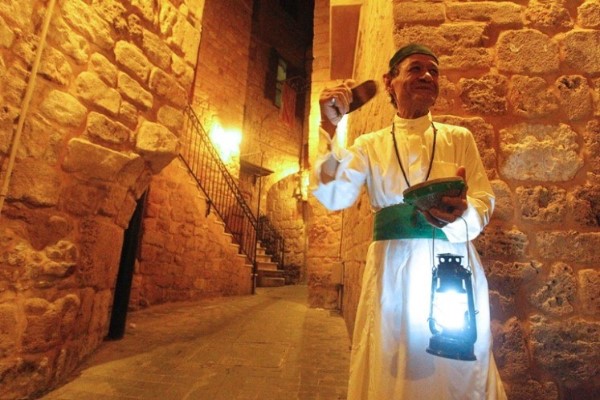
The Prophet, to show its importance, would invite guests to suhur just as he did to iftar. For example, he invited Irbad ibn Sariyah to suhur. He would say, “Have suhur even if it is with a sip of water; there is blessing in it. Suhur supports the fast, and daytime sleep supports night worship.”
Suhur comes from the same root as sahar. It is also known as imsak; it means to hold back, to refrain from something. It is the moment when fajr, that is, the first light of the sun, appears on the eastern horizon. From this moment, the fast begins. This means the time for the morning prayer has entered. As a precaution, one waits a little and then performs the morning prayer. Zayd ibn Thabit says: “After eating suhur with Rasulullah, the time it took to recite fifty verses passed, and then we performed the morning prayer.”
.jpg)
Black Thread – White Thread
When the verse of the Qur’an permitting eating and drinking in Ramadan until the time when the black thread and the white thread become distinguishable from one another was revealed, Adiy ibn Hatim took one black thread and one white thread and placed them under his pillow. When he could not distinguish them during the night, he could not determine the time of fasting. When he explained the situation in the morning, the Prophet joked, “Your pillow must be wide and long.” He explained that the verse was metaphorical, and that the black and white threads meant the darkness of night and the light of day. Indeed, the expression “until dawn breaks” at the end of the verse indicated this.
The Sahaba would rely on the adhan for imsak
and iftar. Bilal al-Habashi would call the adhan first, and Ibn Umm Maktum
would call it later. The Prophet said, “Eat and drink until you hear
the adhan of Ibn Umm Maktum,” because the adhan of Bilal was meant to
wake those who were asleep.
He interpreted the verse in the
Qur’an meaning “Then complete the fast until the night”
as, “When the night comes and the day disappears, that is, when the
sun disappears, then break the fast.”
Two Joys
Before breaking his fast, the Prophet Muhammad would supplicate with words meaning, “O my Lord, I fasted seeking Your approval; I believed in You; I relied upon You; and with Your provision I break my fast. O Lord whose forgiveness is vast! Forgive me, my parents, my descendants, and the believers.” After iftar, he would supplicate with words meaning, “The thirst has gone; the veins have cooled, and the reward has been attained, insha’Allah.” He said, “The fasting person has two joys: one at iftar, and the other when he meets his Lord with this reward.”
On one journey, some were fasting and some were not. They stopped on a very hot day. Those who were fasting collapsed. Those who were not fasting set up the tents and watered the animals. The Prophet said, “Today, those who were not fasting have earned the reward!” When he saw a man for whom people were creating shade because he was fasting, he said, “Fasting while on a journey is not a great act of piety.”
The Prophet Muhammad would lead the Sahaba in twenty rak‘ahs (units of Islamic prayer) of prayer after the night prayer on the nights of Ramadan. Then, fearing that it might be assumed to be obligatory and that the Muslims might not be able to bear it, he preferred to perform part of it alone. He encouraged this prayer, which came to be called tarawih, by saying, “Whoever performs the tarawih prayer with faith and hoping for its reward from Allah, his past sins will be forgiven.” During the month of Ramadan, more lamps would be lit in the Masjid al-Nabawi in honor of these blessed days.
Önceki Yazılar
-
A SULTAN IN THE GRIP OF THE MASONS: MURAD V26.08.2026
-
AN ANCIENT GREEK TRADITION AMONG CHRISTIANS: THE BETTER THE DOWRY, THE BETTER THE HUSBAND19.08.2026
-
WHY DID THE PROPHET MUHAMMAD MARRY MULTIPLE TIMES? Understanding the Prophet Muhammad’s Marital Life12.08.2026
-
HOLY RELICS ADORNING ISTANBUL5.08.2026
-
AN OTTOMAN PRINCE IN THE DESERTS OF LIBYA29.07.2026
-
THE TURKS AT THE GATES OF VIENNA22.07.2026
-
THE SOLE FEMALE RULER OF TURKISH-ISLAMIC HISTORY15.07.2026
-
SIYASATNAMAS: THE FORGOTTEN SCHOOLS OF POLITICS8.07.2026
-
Urban Dwellers, Peasants, and Nomads in the Ottoman Empire: TURKS ARE A NOMADIC PEOPLE, AFTER ALL1.07.2026
-
EUROPE’S POLYGAMISTS24.06.2026