.jpg)
ÇANAKKALE: REGRET AWAITS BOTH WHO PASS AND WHO DO NOT
The Dardanelles (Çanakkale) Strait, which did not allow passage thanks to a glorious defense in 1915, was passed by the Allies in 1918 following the defeat of the Ottoman army. One hundred years earlier, the British had passed through Çanakkale once again. But how?...
It was the final years of the reign of Sultan Selim III. The French ambassador Sebastiani had gained great influence in Istanbul. He was inciting the government to wage war against Russia. England, which was at war with France, was greatly disturbed by this. The British ambassador in Istanbul, Arbuthnot, demanded that the Ottoman government sever its political relations with the French and renew its alliance with them (the British).
When this demand was not fulfilled, he secretly went to Bozcaada at night and set the British fleet in motion. On 20 February 1807, sixteen British ships, taking advantage of the weakness of the fortifications and accompanied by a southwesterly wind (lodos), passed through the Dardanelles Strait and entered the Sea of Marmara. A few insignificant cannon shots were fired from the strait batteries, but none hit their target. The Ottomans were not accustomed, in times of peace, to keeping defensive troops stationed in the fortresses.
They Raised an Uproar
When the situation was heard in Istanbul, everyone fell into panic. The bombardment by the ships was sufficient to destroy the city, most of whose houses were wooden. The French ambassador destroyed his private archives and prepared to flee the city. Meanwhile, the shores of the strait were immediately fortified. British Admiral Duckworth came to the front of Istanbul. He delivered a note demanding that the Dardanelles Strait be given to England and Romania to Russia; additionally, he demanded that the Ottoman fleet be handed over to him to be taken to Malta.
The people believed that the peace-loving sultan would accept the British offer. An elderly harem agha applauded the sultan, who was preparing to reject the offer, by saying that the people of Istanbul were stronger than the British fleet and that the ships could do nothing but make an uproar. The government delayed the British ambassador for five days with negotiations and completed the fortifications. A total of 1,250 cannons were placed along the shores.
The Disappointment of the British
Instead of taking advantage of the chaos, the British ambassador issued a second note after five days and waited for an answer. Meanwhile, Sultan Selim III personally took command of the troops and came beside the fortifications. French officers and soldiers in the city also joined the defense. The people of Istanbul stood ready with swords in their hands, prepared to board boats and attack the ships the moment the British artillery opened fire.
The next day, seeing the situation, the British suffered great disappointment. The ambassador delivered a third note, but it was not as harsh as the previous ones. He demanded that the fortifications be halted. The people poured into the streets in joy.
Under these circumstances, had the British opened fire, it could have caused a great massacre. The French ambassador hoisted his tricolor French flag on his boat and proudly cruised in front of the fortifications. The British did not even consider firing a single rifle shot at him. Admiral Duckworth waited like this for a few days, then withdrew to the islands to obtain fresh water.
Even before the negotiations ended, the withdrawal of the fleet further raised public morale. In the meantime, the admiral’s son, who had gone ashore on Kınalıada with a small number of soldiers to fetch water, was captured. The British were rendered unable even to move from one ship to another. As a result, on 1 March the British fleet was forced to retreat at a trot, exit into the Aegean Sea amid the jeers of the people, and thanked God.
European Interest in the Straits Is Not New
The Dardanelles Strait has a brilliant history. Leandros, who swam across the strait to see his beloved Hera, once drowned amid raging waves when the lantern held by his beloved was extinguished by the wind and he could not reach the opposite shore.
The eccentric city of ancient times, Troy, is nearby. After their famous defeat, the Trojans fled and founded Rome. Europeans frequently came to these places to search for the ancient city of Troy, which they had learned about from the epics of Homer and the history of Strabo. Most recently, a German named Schliemann found the city. He fled at the first opportunity with as much treasure as he could carry. With each passing day, it is becoming clear that Troy was a much larger city.
The Roman emperor Constantine wanted to establish his capital here, at İntepe. He even began construction. Towers and walls were raised. However, lightning flashed from an unknown direction. Then a light glided upward into the air and disappeared from sight. In his dream, the emperor received advice to abandon founding the city here and instead have it built where Istanbul is located. Emperor Justinian had large grain warehouses built in Çanakkale to supply food to Istanbul. Ships coming from Egypt could not pass through the Dardanelles Strait when the north wind did not permit it; they would unload their cargo at Tenedos (Bozcaada) and then set sail again.
Muslims and the Strait
In the year 715, Muslims crossed into the European continent from here for the first time. The Umayyad prince Maslama ibn Abd al-Malik crossed to Gelibolu (Gallipoli) and, circling from the north of the Sea of Marmara, laid siege to Istanbul. His brother, Caliph Sulayman, also sent assistance by ships. Galata fell. The emperor was greatly frightened. However, the Muslim weapons that achieved victory everywhere proved ineffective against what the Greeks called ignis graecus, “Greek fire.” After the Muslims had remained in Karaköy for several years, Sulayman passed away and Umar ibn Abd al-Aziz became caliph, and they returned.
In the year 1399, when Sultan Bayezid I besieged Istanbul, a French fleet that came to provide aid joined with Venetian and Genoese ships and forced seventeen Ottoman galleys to retreat in front of the Dardanelles. During the siege of Crete in the 17th century, Venetian ships won victories off the Dardanelles. The Ottoman fleet was dispersed. However, a fire broke out on the Venetian flagship and Admiral Mocenigo was seriously wounded. The Venetians withdrew in despair. Thereupon, the Ottoman government had two fortresses built on both sides for the defense of the strait.
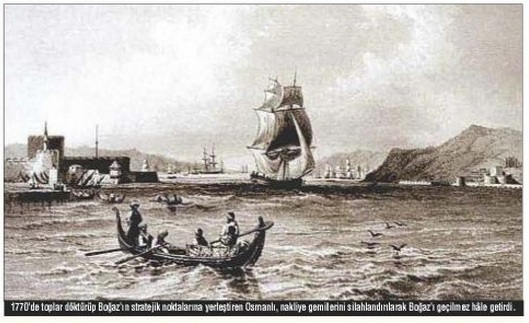
In the year 1770, when the Ottoman fleet was burned at Çeşme by the Russo-British allied fleet, the British admiral Elphinstone proposed to the Russian admiral Orlov that he force the Dardanelles Strait. Orlov refused. The Sublime Porte (the government of the Ottoman Empire), with the assistance of the French artillery officer in Ottoman service, Baron de Tott, immediately fortified the Dardanelles Strait. Thirty thousand soldiers and newly cast cannons were placed on both sides of the strait. Many transport ships were armed, rendering the strait impassable. This time, the Russian fleet, which came to the front of the strait to try its luck at the insistence of the British, encountered these fortifications and turned back. From the events of 1807, it is understood that these fortifications were later neglected.
Önceki Yazılar
-
“IF YOU REALIZE THAT YOU ARE WRONG, DO NOT HESITATE TO RETURN TO WHAT IS RIGHT!”30.09.2026
-
HE WAS TO BECOME SULTAN, YET HE DOES NOT EVEN HAVE A GRAVE: PRINCE ORHAN EFENDI23.09.2026
-
IS IMPRISONMENT A PUNISHMENT FOR THE CONVICT, OR FOR HIS INNOCENT FAMILY?16.09.2026
-
ABORTION AND INDUCED MISCARRIAGE IN HISTORY9.09.2026
-
EUROPE SHOULD LEARN TOLERANCE FROM THE EAST2.09.2026
-
A SULTAN IN THE GRIP OF THE MASONS: MURAD V26.08.2026
-
AN ANCIENT GREEK TRADITION AMONG CHRISTIANS: THE BETTER THE DOWRY, THE BETTER THE HUSBAND19.08.2026
-
WHY DID THE PROPHET MUHAMMAD MARRY MULTIPLE TIMES? Understanding the Prophet Muhammad’s Marital Life12.08.2026
-
HOLY RELICS ADORNING ISTANBUL5.08.2026
-
AN OTTOMAN PRINCE IN THE DESERTS OF LIBYA29.07.2026