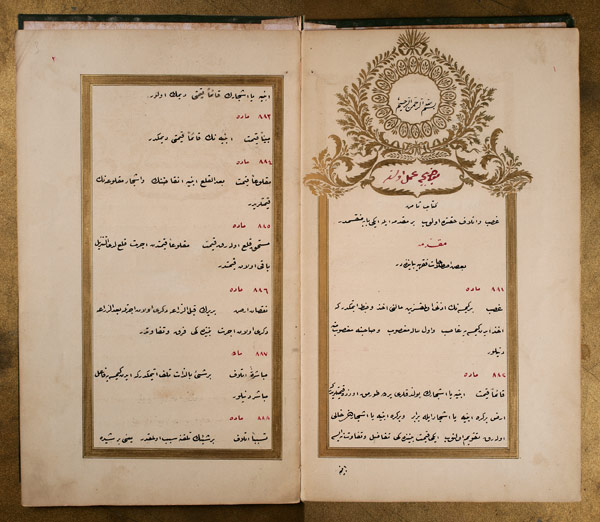
THE MECELLE THAT TRIUMPHED OVER THE FRENCH CIVIL CODE
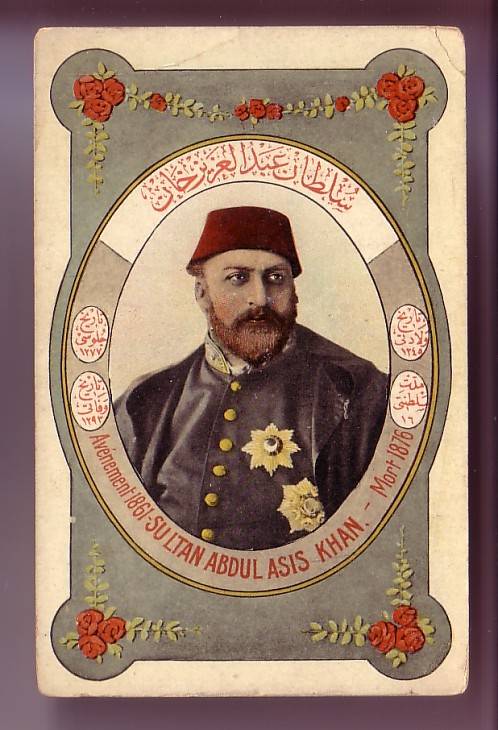
The Mecelle is a civil code prepared during the reign of Sultan Abdulaziz. However, due to its high qualities it gained worldwide prestige and was applied for many years in states that had broken away from the Ottomans, especially in Israel.
Relations between the Ottoman Empire and Europe changed during the 19th century. The appearance of a constant state of war gave way to peace. At the Paris Conference of 1856, the Ottoman Empire was accepted as one of the the Great Powers, that is, one of the five greatest states in the world. European merchants began coming and going to the Ottoman lands. The Ottomans became reacquainted with Europe.
Let Us Know What Your Law Is!
Meanwhile, an intense reform effort was underway in the country. New courts and new laws were being created; new institutions were being established; efforts were being made to prevent backwardness. The Ottoman Empire was assuming the appearance of a modern state by trying to comply with the requirements of the age. Within this framework, Europeans were exerting pressure by saying: “Whatever your law is, set it forth so that we may know it.”
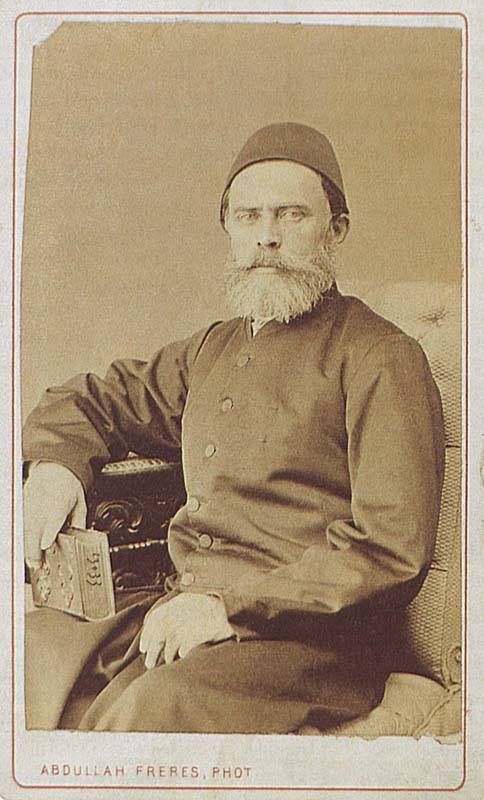
In fact, the Ottoman Empire already had laws. However, these texts, which originated from the sharia (Islamic law), were in Arabic. Judges of the newly established courts had difficulty understanding them. The pro-French Grand Vizier Ali Pasha thought of adopting the French civil code Code Civile Napoléon, which was very popular at that time. He even had it translated. However, conservatives led by the great scholar Ahmed Cevdet Pasha stood firmly against him. They said that adopting a foreign law would be dishonorable. When opposing an idea, one must present its alternative. Cevdet Pasha did exactly that. By establishing the Mecelle Cemiyeti (Mecelle Commission), he succeeded in turning Islamic law, which was already in force in the country, into a code in the European style.
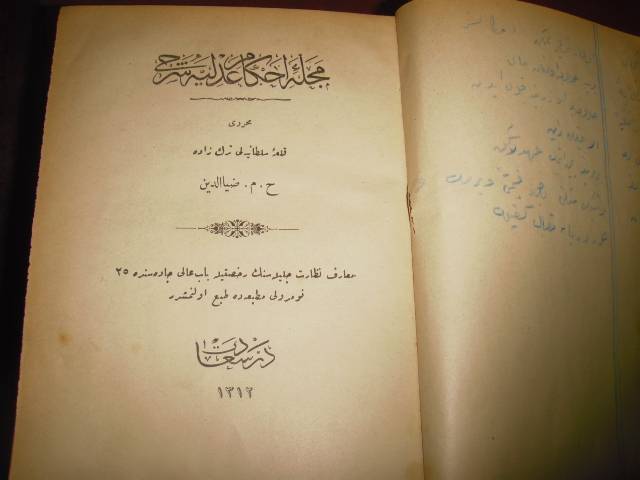
The committee, composed of the most distinguished Islamic jurists of the time and headed by Cevdet Pasha, succeeded in completing the Mecelle-i Ahkam-i Adliyye between the years 1869 and 1876 after intermittent and eventful work. Mecelle-i Ahkam-i Adliyye means “collection of judicial rulings.” It was the joint work of a committee of scholars. However, Cevdet Pasha’s role and effort in its preparation were greater than anyone else’s. Knowing what it means to refer matters to a commission, he did not wait for the entire work to be completed; instead, as each section was prepared, it was proclaimed as law by the decree of Sultan Abdulaziz.
Articles Explaining What Ought to Be
The Mecelle, consisting of 1,851 articles, contains no provisions concerning the law of persons, family law, or inheritance law. This is because these belonged to the sphere of the shar‘i (religious) and ruhani (ecclesiastical) courts. The Mecelle, on the other hand, was primarily issued for the newly established nizamiye courts (regulatory tribunals). Provisions relating to criminal law, taxation, and land law were also regulated by other laws. The Mecelle contains the following subjects: sale, lease and hire of services, suretyship (kafala), transfer of debt (hawala), pledge (rahn), deposit (wadiʿa), trust or entrustment (amana), gift (hiba), usurpation and damage (ghasb and itlaf), interdiction (hajr), coercion (ikrah), pre-emption (shufa), partnership (shirka), agency (wakala), settlement (sulh), release (ibra), acknowledgment (iqrar), legal claim (dava), evidence (dalil), oath (yamin), and adjudication (qaza).
The first one hundred articles of the Mecelle consist of general legal principles. They explain how rulings are derived from the sources of fiqh (Islamic jurisprudence). These are rulings expressing what ought to be and which European law reached only after many struggles. These one hundred articles, which earlier jurists almost knew by heart, still constitute a valuable source for modern jurists today in terms of legal reasoning and interpretation:
“Matters are judged according to their intentions”; “Certainty is not removed by doubt”; “Freedom from liability is the fundamental presumption”; “Hardship begets facility”; “Necessities render prohibited things permissible”; “Of two evils, the lesser is chosen”; “Custom is authoritative”; “The change of rulings with the change of times cannot be denied”; “Liability goes with benefit…”
.jpg)
Israel Was the Last to Abandon the Mecelle
The Mecelle was applied for 57 years in the Ottoman Empire until the adoption of the Swiss Civil Code in 1926. It was translated into Arabic, Bulgarian, Greek, Armenian, French, and English. Commentaries were written about it. At that time it was not applied in Egypt and Tunisia, which were autonomous provinces. When the Principality of Bulgaria was established, they accepted the Mecelle as the basis of their new legislation. Many provisions in the civil codes of Serbia and Montenegro were taken from the Mecelle.
In North Yemen, where the Zaydis ruled, it was abolished from practice immediately after the end of Ottoman rule (1918). It continued to be applied in Albania until 1928, in Cyprus until 1946, in Syria until 1949, in Iraq until 1951, in Jordan until 1976, and in South Yemen until 1992. Nevertheless, it is possible to see traces of the Mecelle in the new civil codes enacted in those countries. In Jordan, judges are obliged to consult the Mecelle on matters they cannot find in legislation.
In Lebanon, most articles of the Mecelle were abolished in 1934; however, judges were obliged to consult it in matters for which they could not find a solution in legislation. In Palestine, the application of the Mecelle continued even after the British occupation and even after the establishment of Israel. In Israel, the Mecelle was abolished in 1984. However, it is possible to see the influence of the Mecelle in Israeli laws. Many provisions of Israel’s law of real rights were also taken from the Mecelle. In both Lebanon as well as Israel and Palestine, some provisions of the Mecelle remain in force for Muslims.

Both Were Prepared in Istanbul
The Mecelle was the first attempt to gather together the principles of fiqh. Because it demonstrated that fiqh could be transformed into statutory law, it aroused great respect in the Islamic world. No contradictions are encountered among its provisions. It has a clear and elegant style that is easy to understand. Its articles are extremely concise and clear. Placing the terminology related to each subject at the beginning of every book, and giving examples in each article, made the rulings easier to understand and apply.
The first law prepared in Europe through a scientific society was the code of Emperor Justinian, which was prepared in Istanbul. It forms the basis of European laws. The second was the Mecelle. By taking the initiative in preparing the Mecelle, Cevdet Pasha rendered a great service not only to Islamic law but also to the legal life of the world; he immortalized both his own name and that of his work.
As a human work, the Mecelle is of course not flawless. However, this did not cast a shadow on its reputation; on the contrary, it demonstrated that laws suitable to the needs of the time could be produced from twelve centuries of Islamic law. Indeed, if circumstances had been favorable, the committee that prepared the Mecelle could have made the necessary additions and corrections. The abolition of the Mecelle occurred not because of its deficiency, but because the preference of Turkey had changed.
Önceki Yazılar
-
POLITICAL POWER AND ITS INNER CIRCLES THROUGHOUT HISTORY21.10.2026
-
THE LAST EMPEROR’S SORROWFUL DAYS IN SAN REMO14.10.2026
-
WHO WAS THE OTTOMAN JUDGE?7.10.2026
-
“IF YOU REALIZE THAT YOU ARE WRONG, DO NOT HESITATE TO RETURN TO WHAT IS RIGHT!”30.09.2026
-
HE WAS TO BECOME SULTAN, YET HE DOES NOT EVEN HAVE A GRAVE: PRINCE ORHAN EFENDI23.09.2026
-
IS IMPRISONMENT A PUNISHMENT FOR THE CONVICT, OR FOR HIS INNOCENT FAMILY?16.09.2026
-
ABORTION AND INDUCED MISCARRIAGE IN HISTORY9.09.2026
-
EUROPE SHOULD LEARN TOLERANCE FROM THE EAST2.09.2026
-
A SULTAN IN THE GRIP OF THE MASONS: MURAD V26.08.2026
-
AN ANCIENT GREEK TRADITION AMONG CHRISTIANS: THE BETTER THE DOWRY, THE BETTER THE HUSBAND19.08.2026