(1).png)
AN ANCIENT GREEK TRADITION AMONG CHRISTIANS: THE BETTER THE DOWRY, THE BETTER THE HUSBAND
A Payment of Courtesy
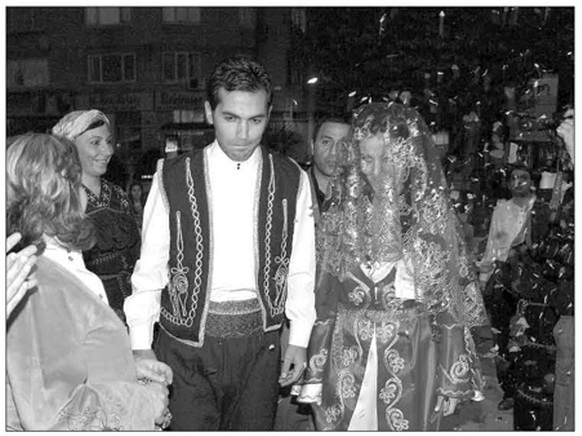
Before Islam, among the Turks it was customary for the man who was to marry to give money or property called "kalın" to the girl’s family. The most acceptable form was payment made in sheep. Unless it was paid, the marriage would not take place. The girl could not be taken to her husband’s house. A portion was given to the father when the engagement was concluded. A portion was a gift to the girl. A portion covered the wedding expenses. A portion was given to the girl’s mother as milk right (a traditional payment acknowledging the mother’s nursing).
If the man broke off the engagement without cause, the kalın was not returned. If the girl broke off the engagement, it was returned. If the man died while engaged, his brother would take his place and the kalın would not be returned. If the man’s brother did not accept, the kalın was not returned. If there was no brother or the woman did not consent to such a marriage, the kalın was returned. If the girl died while engaged, her sister would take her place; an additional amount was added to the kalın for the sister. If the sister did not wish to marry or did not exist, the kalın was returned.
After the Turks entered Islam, they abandoned this custom, yet today it partially survives in Anatolia and Turkestan under the name "başlık" (bridewealth). In Islam, asking the groom for something in order to accept the girl’s marriage is bribery and is not permissible (jaiz). Even if the groom promises, he is not obliged to give it. If he has given it, he may take it back.
A House from the Groom to the Bride
In Islam, the man who is to marry gives the woman money or property under the name mahr (dower). Even if mahr is not mentioned during the marriage contract (nikah), or even if it is agreed that no mahr will be given, the woman is still entitled to mahr. It is not the right of the woman’s family, but directly the right of the woman herself. It exists in most ancient societies, including Judaism.
The value of the mahr cannot be less than 10 dirhams of silver (5 grams of gold). During the time of the Prophet Muhammad (peace be upon him), two sheep could be purchased with this amount. A woman without support could milk one and drink it; with the wool, she could sell the milk of the other and obtain her other essential needs. For the validity of the marriage, it is not a condition that mahr be mentioned. Therefore, to regard it as a sale price is incorrect. Mahr is for the orderly and happy continuation of marriage, for the protection of the woman’s rights and freedoms, and so that she does not become a plaything in the hands of an ill-intentioned man. Because of the obligation to pay the mahr, to provide nafaqa (financial support) for his children, and to pay a new mahr in order to remarry, a man cannot easily divorce his wife. In places where divorce is frequent, the mahr is set high. For example, in Arabia, a house is generally given to the woman as mahr. Moreover, no one wishes to give their daughter to a man who has divorced his wife. For this reason, although divorce is easy, cases of divorce were very rare in Islamic lands throughout history.
A Priority Claim
Mahr al-musamma (named mahr) is the amount discussed and agreed upon by the parties before marriage. If it has not been discussed, the woman is given mahr al-mithl (equivalent mahr). This is the mahr of women equal to her in that locality. If this also cannot be determined, the mahr of her paternal relatives such as her sister, paternal aunt, or paternal cousin (not her mother or maternal aunt) is taken as the basis.
If it is agreed that all or part of the mahr will be paid in advance, this is called mahr al-muʿajjal (mehr-i muaccel). It means mahr that has been advanced or made immediate. In Anatolia, this is called "ağırlık" and is given before the wedding as part of the trousseau expenses. The woman does not allow the marital consequences (consummation) without receiving the mahr al-muʿajjal. If it is agreed that all or part of the mahr will be paid later, this is called mahr al-muʾajjal (mehr-i müeccel). It means mahr that has been deferred and bound to a term. If the date of payment is not specified, it is paid immediately after death or separation.
Even if the woman causes the divorce, she receives her mahr. Mahr is a claim with priority over other debts; it is paid first from the property of the deceased or the bankrupt. If the woman dies, the husband pays it to the woman’s heirs. If the husband dies, it is given to the woman from his property. The woman may gift her mahr to her husband. If they separate before consummation (zifaf) or before being alone together, the woman is entitled to half of the mahr; if mahr was not discussed, the woman is given a complete outfit from head to toe.
Why Is the Population Decreasing?
Among Christians, the girl who marries pays drahoma (dowry) to the man. We learn that this remains from Ancient Greece from the letters of Plato. The drahoma is announced in advance. Even if a girl with a high drahoma is unattractive, her suitors are distinguished. During a trip to Greece, I learned from a friend there that the Greek population was gradually decreasing, and I asked the reason. He replied: “Among us, the drahoma custom still continues. Young people live as they wish. Since I will marry only once, I say I should marry a girl with a high drahoma. For this reason, girls wait, their ages pass. When they finally marry, they may have one child, or perhaps none.” The drahoma custom has also passed to the Jews. A Jewish woman named Rachel, who sewed our grandmother’s wedding dress, used to live with her sister, who was also past marriageable age like herself. When it was asked why they had not married, although they were so skillful and beautiful—this woman who was understood to have once been quite beautiful—it was learned that no one had taken them because they had no drahoma. The poor woman would sigh and say, “Your custom is good; ours is bad!”
You Must Pay Extra
The English officer Frederick Burnaby, who traveled throughout Anatolia in 1876, was surprised to see that the Armenians took money from the groom; upon this, an Armenian from Karakilise (Ağrı) said to him: “When our daughters marry, we are deprived of their service. The husband must compensate this loss. Europeans educate their daughters, but those girls are of no use for cleaning and cooking. When they marry, their fathers lose nothing. On the contrary, they profit, because they will no longer pay for their daughters’ food and clothing. It is only right to give something to a husband for undertaking a useless burden.”
Önceki Yazılar
-
IS IMPRISONMENT A PUNISHMENT FOR THE CONVICT, OR FOR HIS INNOCENT FAMILY?16.09.2026
-
ABORTION AND INDUCED MISCARRIAGE IN HISTORY9.09.2026
-
EUROPE SHOULD LEARN TOLERANCE FROM THE EAST2.09.2026
-
A SULTAN IN THE GRIP OF THE MASONS: MURAD V26.08.2026
-
WHY DID THE PROPHET MUHAMMAD MARRY MULTIPLE TIMES? Understanding the Prophet Muhammad’s Marital Life12.08.2026
-
HOLY RELICS ADORNING ISTANBUL5.08.2026
-
AN OTTOMAN PRINCE IN THE DESERTS OF LIBYA29.07.2026
-
THE TURKS AT THE GATES OF VIENNA22.07.2026
-
THE SOLE FEMALE RULER OF TURKISH-ISLAMIC HISTORY15.07.2026
-
SIYASATNAMAS: THE FORGOTTEN SCHOOLS OF POLITICS8.07.2026