(1).jpg)
EUROPE SHOULD LEARN TOLERANCE FROM THE EAST
Europe, which lacks a tradition of coexistence, is now thinking about what to do with Muslims whose number has reached millions. There are those who say, “Those who are not like us have no right to live.” Does this problem perhaps bring about the end of the much-praised European Culture?
In the recent past, tension in Belgium, which began when the police intervened with a Muslim woman whose face was covered, increased when a marginal Islamist organization stabbed two police officers. After this, 100 people gathered in front of the Royal Palace and shouted slogans against Muslims and Islam. One of these was: “Muslims who are not like us, out!” Moreover, the leader of the People’s Party, Modrikamen, said: “Those who come to Belgium must accept our values. For this reason we are against sharia. Whoever does not respect the values of this country should be sent away. If until now we have been afraid of the Islamists, from now on they should be afraid of us.” What a shame that such a mentality exists in this day and age!

The Tradition of Coexistence
Come and see what Islamic sources say about “living together”: One of the conditions necessary for a state to be accepted as dar al-Islam (lands ruled by Islam), that is, an Islamic State, is that the religious freedom of non-Muslims must be guaranteed. This guarantee given by the Prophet Muhammad (peace be upon him) is not limited only to Jews and Christians who are called Ahl al-Kitab (the People of the Book). The Islamic State does not interfere with the beliefs of those within its borders, whether they are Zoroastrians, polytheists, or Dahris (atheists). It grants them the status of dhimmi (non-Muslim citizens protected by the Islamic State). Although the principles of belief state that non-Muslims will be eternally in Hell, it is clear that Muslims have displayed remarkable tolerance in worldly affairs. This too is one of the principles of Islam.
In the Islamic State, it cannot be forbidden for non-Muslims to practice their religions, teach them, or worship in their temples. Muslims and non-Muslims are not equal in religion, but they are equal before the law. Those who think and live differently can live comfortably and express themselves as long as they do not attempt to change the order of the state and society in practice. Crimes committed against non-Muslims are subject to the same punishment as those committed against Muslims. In fact, since they are left to their own religion, non-Muslims are in a freer position than Muslims, who are obliged to comply with the principles of the religion of Islam. For example, a non-Muslim may drink wine and sell it. Even according to the sharia, if a Muslim spills the wine of a dhimmi, that Muslim must compensate for it.
.jpg)
Separate Meals for Jewish Students
In Islamic history it is known that differences of opinion existed both in religious and political life. The first of these were the Kharijites. The Kharijites were also the sect that produced the first terrorists of the Islamic world. One of the famous scholars of later periods, Ibn Abidin, describes them as “a group possessing soldiers and power, who consider it lawful to take the blood and property of the Ahl al-Sunnah, to enslave their children and women, and who attribute disbelief to the Sahaba (companions of the Prophet).” Despite all this, he said: “We, the Ahl al-Sunnah, do not attribute disbelief to the Kharijites. For although their interpretations are false, they are correct according to themselves,” and thus kept this group within the circle of the religion.
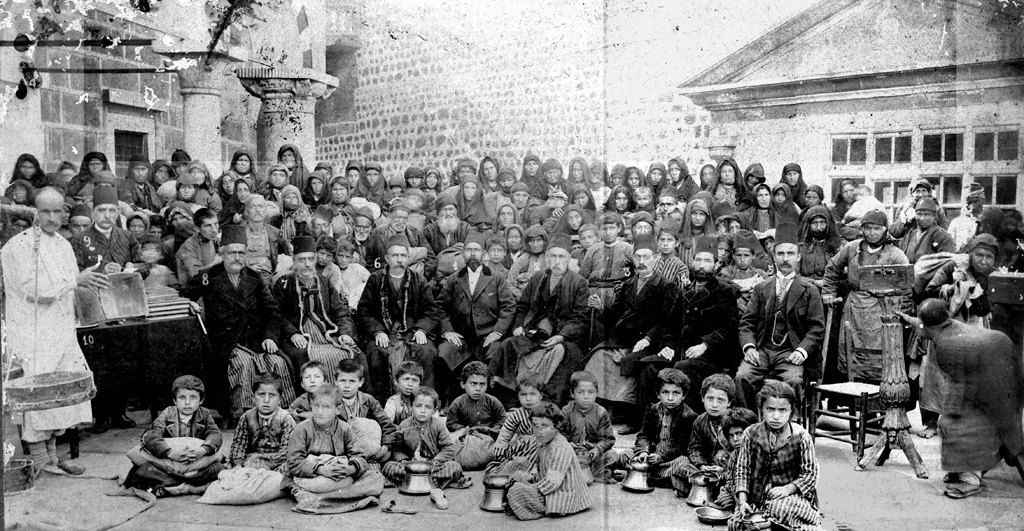
In the Islamic/Ottoman State, non-Muslims were subject to their own law. They had their own courts. Sultan Abdulmajid ordered that a kitchen be established at the Imperial School of Medicine to prepare food according to the kosher rules of their religion for the Jewish students studying there, and that their sacred day, Shabbat (Saturday), be observed as a holiday. The Ottoman navy would anchor so that non-Muslim officers and soldiers could go to their homes on days such as Christmas, Easter, and Passover. At no time was it said that “those who do not integrate with us have no right to live.”
At Christmas, the Christian ships in Galata—on the condition of obtaining permission from the government beforehand—could celebrate by firing their cannons. This is related by the historian Mustafa Naima. Today it is unimaginable that such a thing would be permitted. According to Islamic law, Christians in Muslim lands cannot build churches as they wish. Permission must be obtained from the government. The government behaved leniently in matters of churches. For Turks were accustomed to seeing churches in Turkish cities, and there was no Turk who showed fanaticism against this.
In 1643, during the reign of Sultan Ibrahim, the qadi (judge) of Bursa, Hocazade Mesud Efendi, who later became sheikh al-Islam, had a church demolished that Christians had built without permission in Bursa. Because he had the church demolished without asking him, the Grand Vizier Silahdar (sword-bearer) Kara Mustafa Pasha dismissed Mesud Efendi from the judgeship of Bursa. The incident offended the people of Bursa. Something unprecedented happened. The people rose up and destroyed three churches. The Divan (the imperial council) punished the leaders of the uprising and paid compensation to the Rum (Greek Orthodox Christian) community that owned the church. It was something Europe could not have comprehended.

Either Baptism or Death!
This is the manifestation of tolerance shown to those who are not like oneself. It is not easy to find an example of this in European history. With the conquest of Andalusia, the Jews and Muslims there were given the alternative of either baptism or death. Is it surprising then that, after years of sectarian wars in which they slaughtered their own co-religionists, thousands were burned in fires on accusations of difference in belief? Although nearly five hundred years have passed, it is strange that Europe, which gives lessons of humanity, has not been able to learn tolerance toward people of different religions and thoughts.
It is not difficult to understand Europe. With the influence of colonialism, many people rushed to Europe with concerns for life and livelihood. These people, who were incapable of living even with their own co-religionists, could hardly live together with Christians. Most of them were ignorant of their own religion. When they were subjected to discrimination, they retreated into a kind of religious fanaticism. Europe had never had experience in living with those who were not like itself. Moreover, empires possessing multi-religious, multilingual, and multicultural communities have collapsed. These empires offered a far more humane and democratic framework than the monstrosity of the nation-state. Differences were not seen as strange; they were even welcomed. Empires showed tolerance to those who thought and lived differently. They did not try to make them resemble the majority. This is precisely why these empires endured for centuries.
Reason Leads to the Same Conclusion
Rome was a Mediterranean empire. It adopted and embraced human values from the East, especially under the influence of Christianity. In the Islamic/Ottoman Empire, the legal status of those outside the ruling element was clearly defined. Far from assimilation, everyone is expected to remain as they are. No one finds this unusual. The Chinese Empire was like this. Habsburg Austria was like this. Even the Russian Tsardom was like this, until it was crushed by the steamroller of communism.
The British Empire is the last and living example of this. It is still the only state that embraces its imperial heritage without falling into a complex. England, two steps beyond Europe, approaches the matter in the fashionable expression as “solution-oriented.” It has granted Muslims the freedom to establish their own schools and even their own courts. The idea that “only those who resemble us have the right to live” would mean the suicide of Europe. If Europe’s pride does not allow it to learn tolerance from the East, then at least let it look at England! And let the East lament the empire it has lost!
.jpg)
Önceki Yazılar
-
WHO WAS THE OTTOMAN JUDGE?7.10.2026
-
“IF YOU REALIZE THAT YOU ARE WRONG, DO NOT HESITATE TO RETURN TO WHAT IS RIGHT!”30.09.2026
-
HE WAS TO BECOME SULTAN, YET HE DOES NOT EVEN HAVE A GRAVE: PRINCE ORHAN EFENDI23.09.2026
-
IS IMPRISONMENT A PUNISHMENT FOR THE CONVICT, OR FOR HIS INNOCENT FAMILY?16.09.2026
-
ABORTION AND INDUCED MISCARRIAGE IN HISTORY9.09.2026
-
A SULTAN IN THE GRIP OF THE MASONS: MURAD V26.08.2026
-
AN ANCIENT GREEK TRADITION AMONG CHRISTIANS: THE BETTER THE DOWRY, THE BETTER THE HUSBAND19.08.2026
-
WHY DID THE PROPHET MUHAMMAD MARRY MULTIPLE TIMES? Understanding the Prophet Muhammad’s Marital Life12.08.2026
-
HOLY RELICS ADORNING ISTANBUL5.08.2026
-
AN OTTOMAN PRINCE IN THE DESERTS OF LIBYA29.07.2026