IF THE PALACE CANNOT TEACH YOU MANNERS, NOWHERE CAN! THE HEART OF THE STATE, THE MIRROR OF THE EMPIRE
In the Ottoman Empire, the palace was not merely a building in which the sultan resided. It was the heart of a great organism: the centre of state administration, the source of culture and art, and a reflection of the empire’s worldview. These palaces were not only the spatial manifestation of state authority embodied in the person of the sultan, but also the places where the order of Ottoman society and its political outlook could be seen most clearly.
The classical Ottoman Palace was a university. It trained thousands of officers, statesmen and artists. It served as a barracks for part of the army. It provided a livelihood for thousands of families. It housed many essential institutions that sustained the empire. All these were given an ornate form that displayed the magnificence of the sultan—or, more precisely, of the empire embodied in his person. (Büyük Türkiye Tarihi [The Great History of Turkey], by Yılmaz Öztuna, IX/122)
In Ottoman history, the term palace refers to the sultan’s palace. The houses in which members of the dynasty lived were also called palaces, however modest they might be. No other buildings were called palaces. The palaces were not the sultan’s personal property; they belonged to the Hazine-i Amire (the state treasury). However, the sultan personally covered the expenses of the harem and other household costs from his own treasury.
The first Ottoman palace in Bursa was burned and destroyed during Emir Timur’s occupation. In later years, Edirne Palace, where the sultans also came to reside, was turned into an ammunition depot in the final century of the empire. During the War of ’93 (the Russo-Ottoman War of 1877–1878), it was blown up to prevent it from falling into enemy hands. Only a small portion remains standing.

From the Old to the New
In Istanbul, the sultans resided at the Old Palace (Eski Saray or Saray-i Atik in Turkish), on the site of what is now the rectorate of Istanbul University. In earlier times, a Byzantine palace had stood there. Sultan Mehmed II, however, was dissatisfied with the palace’s location in the middle of the city, in such a bustling area. He began constructing a new palace.
Topkapi Palace was a charming triangle, with the sea on two sides and the city on the third. It stood amid gardens. Its location was far more suitable and beautiful than that of the Old Palace. Sultan Mehmed II spent the final years of his life there. The Tiled Pavilion (Çinili Köşk) dates from his reign. During the reign of Sultan Suleiman I, the court moved here in its entirety. The family of the preceding sultan would be transferred to the Old Palace. Built of timber, the Old Palace burned down in 1715.
Although its official name was the New Palace (Saray-i Cedid), the public came to call it Topkapi (“Cannon Gate”) Palace, after the cannon positioned near its gate by the shore. Built on an area of 700,000 square metres, the palace overshadowed its counterparts around the world, including the French royal palace.
For three and a half centuries, Topkapi Palace was virtually the centre of the world. From the reign of Sultan Mahmud II onwards, it was gradually abandoned for health-related and social reasons. It became a ceremonial palace used for occasions such as accession ceremonies, funerals and visits to the Khirqa al-Sa‘ada (the Blessed Mantle of the Prophet Muhammad, peace be upon him). Only the attendants of the Enderun (the palace school and inner palace service) remained there.

A World Within Three Courtyards
Throughout Ottoman history, the sultans resided in different palaces as the empire expanded, needs changed and circumstances evolved. Yet the most famous, without question, was Topkapi Palace. It is known that the palace population at times exceeded 4,000 people, including those who stayed overnight and those who attended during the day.
For approximately four centuries, it served as the sultans’ official residence. The centre of state administration was located here, and the sultan’s life unfolded among these courtyards, pavilions, council chambers and the harem. The construction of the palace continued for a century and a half, with successive additions.
Topkapi Palace was not a single building but a vast complex consisting of interconnected courtyards, pavilions, service areas and government offices, each with its own specific function. Indeed, Ottoman architecture had no monumental palace buildings in the European sense. The term palace (saray) referred to an ensemble of pavilions scattered throughout gardens. This arrangement was rooted in the ancient Turks’ attachment to the tent.
Topkapi Palace was divided into three sections, each accessed through a gate: the Bab-i Humayun, the Babussalam and the Babussaade. The first courtyard, known as Alay Meydani (the Parade Ground), was open to the public and contained various state offices. It was surrounded by gardens. The mint, armoury, bakery, hospital and wood store were located here.
Only authorised personnel could enter the second courtyard, also called Birun, or the outer palace, known as Divan Meydani (the Council Square). Today, the ticket office stands at its entrance. The Divan-i Humayun (Imperial Council) convened at a location called Kubbealti (Beneath the Dome). The empire’s most critical decisions were made here, while the sultan listened to the deliberations through a screened window above. Ceremonies were held in the courtyard. The treasury and kitchens were also located here.
The third courtyard contained the Enderun and the harem. The Enderun served as the sultan’s working quarters. It housed the Chamber of Petitions, where the sultan received visitors, as well as a library, a mosque and the treasury offices. It was also the empire’s most distinguished school. Talented young men received education and training here, developing into statesmen and gentlemen.
The harem, also known as Darussaade, was where the sultan lived with his family; in other words, it was his home. The harem was also a centre in which Ottoman family culture and manners took shape. While the Palace of Versailles had no baths, the Ottoman palaces offered numerous elegant bathhouses.

Is a Palace a Wasteful Extravagance?
In the nineteenth century, the Dolmabahçe, Çırağan and Yıldız palaces were built. There were also smaller imperial pavilions, such as Beylerbeyi, Beykoz, Küçüksu, Ihlamur and Aynalıkavak. These were used to receive guests or provide the sultan with a place to rest during excursions, and they were rarely used for extended stays.
Sultan Abdulmejid left Topkapi Palace and took up residence at Dolmabahçe Palace. Topkapi was no longer suited to the lifestyle and ceremonial requirements of the nineteenth century. It had grown old and become impractical because of additions made at different times. Moreover, it was damp. Sultan Abdulmejid, whose father had died of tuberculosis and who himself suffered from the disease, reportedly said, “If we continue living in this palace, our lineage will die out.”
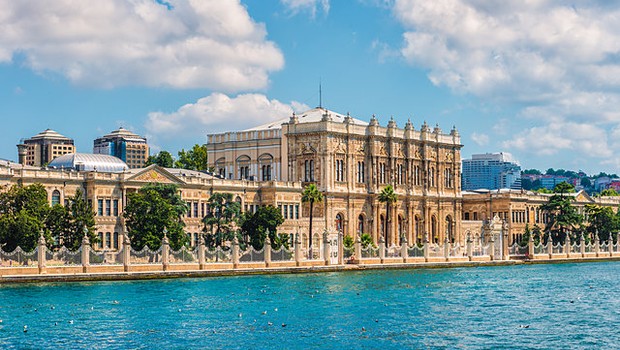
Dolmabahçe Palace is one of the most elegant works of art of the final century of the empire. Even today, it is a source of national pride before the eyes of the world. Thus, the country gained a work of art; and since neither the materials nor the labour had been imported, so much money flowed into the pockets of the people that thousands of families benefited.
Building a palace is not wasteful extravagance but a necessity. A palace is not merely the sultan’s home; it is a place where political, administrative and diplomatic activities are conducted and ceremonies are held. It is the largest government office of all. Moreover, it is a symbol of the empire’s magnificence. Ordinary people judge by appearances and are impressed by grandeur. Nevertheless, these palaces were more modest than the European palaces of their time.
Sultan Abdulaziz and Sultan Mehmed V resided at Dolmabahçe, while Sultan Abdulhamid II and Sultan Mehmed VI lived at Yıldız Palace. Rather than being a single magnificent palace, Yıldız Palace is an ensemble of buildings consisting of small pavilions and structures.
When Sultan Abdulaziz and Sultan Abdulhamid II were deposed, the palaces were plundered, and many precious objects and collections accumulated over centuries fell into the hands of whoever could seize them. After the sultanate was abolished and the dynasty was exiled, the palaces were placed under the authority of the parliament, and most of their furnishings were either distributed among senior state officials or sold.
The first president of the republic resided continuously at Dolmabahçe Palace in Istanbul. He travelled to Ankara only occasionally for official business and stayed there for short periods. He even died in the palace. The second president continued to use it; indeed, his son, who was attending university in Istanbul, lived in the palace. These palaces are among the country’s treasures, whose magnificence should not be surrendered. By welcoming thousands of domestic and foreign tourists every day, they generate substantial revenue.

Like a City
Ottoman palaces possess a unique aesthetic that combines Islamic architecture with Turkish tradition. The most striking feature of Topkapi Palace is that, rather than forming a single, imposing mass like European palaces, it follows a modest yet elegant layout that develops around courtyards. With their extensive gardens, calligraphic and tile decorations, unique works of calligraphy, slender, elongated arcades and airy pavilions, these buildings display some of the finest examples of classical Ottoman aesthetics.
Hierarchy within the palace was defined down to the smallest detail. Every official had a rank, an area of responsibility and rules that they were obliged to follow. This order was vital to preserving the state’s central authority.
The palace constituted both the symbol and the machinery of the empire. For centuries, it ensured the stability of the centralised state system. The unity and continuity of administration were made possible by the palace’s disciplined structure.
Since foreign ambassadors were received at the palace, it stood at the centre of diplomatic relations. It was regarded as one of the most distinguished diplomatic centres of its age.
The palace was a centre of art and learning. Many artists and scholars were trained there. It was the palace that gave direction to the Ottoman artistic atmosphere. Without the palace’s patronage, arts such as miniature painting, calligraphy, tilework and music might not have flourished to the same extent. The palace directly influenced the emergence of the golden ages of Ottoman art.
The Enderun School is regarded as one of the most influential institutions for training administrators in world history. The cultivation of administrators through experience and knowledge strengthened the empire.
A Mirror of Civilisation
Ottoman palaces cannot be regarded merely as buildings made of stone and mortar. They are places that embody the spirit of the empire. Administration, education, art, diplomacy and family life took shape there; every action of the empire originated from this centre.
Life in the palace proceeded, as it were, within the framework of the discipline of a madrasa and the refined manners of a Sufi lodge. The palace is the embodiment of Ottoman refinement. Good manners spread from the palace to Istanbul, from there throughout the Ottoman lands, and from there to the world. It is said that if the palace cannot teach you manners, nowhere can.
The palace’s magnificence derives not from ostentation but from its order, simplicity and architecture, which reflects the seriousness of the empire. The crystal chandeliers of Dolmabahçe and its views of the Bosphorus, meanwhile, express the Ottoman quest for renewal and its response to a changing world.
These palaces still stand today, continuing to whisper the story of an empire. Looking at them, one sees not only the sultans but also the labour, discipline, artistry and imperial vision of the thousands of people who lived there over the centuries.
Önceki Yazılar
-
THE LAST EMPEROR’S SORROWFUL DAYS IN SAN REMO14.10.2026
-
WHO WAS THE OTTOMAN JUDGE?7.10.2026
-
“IF YOU REALIZE THAT YOU ARE WRONG, DO NOT HESITATE TO RETURN TO WHAT IS RIGHT!”30.09.2026
-
HE WAS TO BECOME SULTAN, YET HE DOES NOT EVEN HAVE A GRAVE: PRINCE ORHAN EFENDI23.09.2026
-
IS IMPRISONMENT A PUNISHMENT FOR THE CONVICT, OR FOR HIS INNOCENT FAMILY?16.09.2026
-
ABORTION AND INDUCED MISCARRIAGE IN HISTORY9.09.2026
-
EUROPE SHOULD LEARN TOLERANCE FROM THE EAST2.09.2026
-
A SULTAN IN THE GRIP OF THE MASONS: MURAD V26.08.2026
-
AN ANCIENT GREEK TRADITION AMONG CHRISTIANS: THE BETTER THE DOWRY, THE BETTER THE HUSBAND19.08.2026
-
WHY DID THE PROPHET MUHAMMAD MARRY MULTIPLE TIMES? Understanding the Prophet Muhammad’s Marital Life12.08.2026