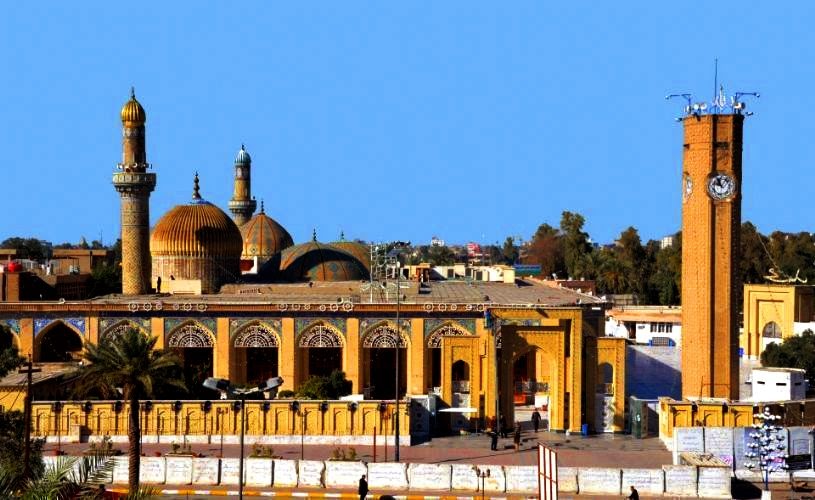
THE WORLD OF IMAM ABU HANIFA
A man who lived in Iraq in the 8th century became a source of guidance and spiritual grace followed by millions — something that no other scholar in history was granted. Abu Hanifa was the founder of the path followed by the Turks, a path that carried them to world dominion.
Whose Father?
Imam Abu Hanifa was born in the city of Kufa, Iraq, in the year 80 AH / 699 CE. His real name was Nu‘man. His ancestors were Persian nobles originating from Kabul, Afghanistan. The father of his grandfather Zuta was Mah (Hurmuz), who served as a marzban (governor) of Baghdad under the Sasanian Empire. Zuta became Muslim at the hands of Caliph Umar and took the name Nu‘man. His father, Thabit, had met Ali ibn Abi Talib and had even received his blessing by offering him faludhaj (a paste of pistachios and butter) on the day of his birth.
Among Arabs, everyone was referred to with the kunya (a traditional form of address) “Abu,” meaning “father of.” The Prophet Muhammad’s (peace be upon him) kunya was Abu’l-Qasim, meaning “father of Qasim.” But this title does not always refer to a person’s child. In Abu Hanifa’s case, the kunya was not given because he had a daughter named Hanifa. Rather, he was called so because he carried at his belt an inkpot-and-pen set known in Iraq as hanifa, or because he transmitted the correct creed (hanifiyyah) to later generations and thus became, in a sense, the spiritual father of the hanifs (those who follow pure monotheism).
His title Imam al-A‘zam (The Greatest Imam) was given to him because he was regarded as a kind of founder of the Sunni creed (Ahl al-Sunnah). Imam in Arabic means “leader,” a title given to scholars whose words serve as authoritative references in religious sciences.
If Faith Were to Reach the Pleiades…
Thanks to his extraordinary abilities, Abu Hanifa devoted himself to learning from a young age. He met a few of the Companions of the Prophet Muhammad (Sahaba) such as Anas ibn Malik and transmitted hadiths from them; thus, he belonged to the Tabi‘in generation — the second of the three groups praised by the Prophet.
He first studied kalam (Islamic theology) and fought against the heretical movements of his time. He systematically compiled the doctrines of faith taught by the Prophet and his Companions. In this regard, he wrote a book called al-Fiqh al-Akbar (“The Great Understanding”). This work is an extremely important text that ensured the transmission of the foundational beliefs of Sunni Islam to later generations.
That is why Sahl ibn ‘Abdullah al-Tustari said, “If such a scholar had existed among the Jews or Christians, they would not have fallen into their present condition.” Scholars have said that the hadith, “If faith were to ascend to the constellation of Thurayya (the Pleiades), a man from among the Persians would bring it back,” refers to Abu Hanifa — for he was of Persian descent. The Pleiades (today part of the Taurus constellation) symbolized remoteness in literature and were also called Ülker and Pervin in Turkish.
Abu Hanifa studied under Hammad ibn Sulayman, one of the leading scholars among the Tabi‘in, for eighteen years. After his teacher’s death, the scholars of Kufa appointed him to his teacher’s chair and accepted him as the city’s mufti (legal advisor).

How Could He Rebel?
During the rule of Marwan, the last Umayyad caliph, the governor of Iraq, Yazid ibn ‘Amr, offered him the position of judge of Kufa. But his piety and devotion, as great as his knowledge and intelligence, led him to refuse. Out of human concern, he feared falling short in safeguarding people’s rights. Saying “Let me consult,” he took leave and went to Mecca, where he stayed for several years.
After the fall of the Umayyads, he returned to Kufa but faced even harsher oppression. In 150 AH / 767 CE, because he refused the position of Qadi’l-Qudat (Chief Judge, equivalent to head of the supreme court) offered by the Abbasid Caliph al-Mansur, he was imprisoned. He died there.
Fifty thousand people attended Imam Abu Hanifa’s funeral. When it was learned that he had requested to be buried in the al-Khayzuran Cemetery in Baghdad, the caliph could not hold back his tears and said, “Even after his death, he is still giving us counsel.” He had not wanted to be buried in the new cemetery that had been expropriated by the state. Al-Khayzuran was an old cemetery.
Over his grave in Baghdad, the Seljuks built a magnificent mausoleum and a madrasa beside it. Ottoman sultans later repaired and adorned this shrine many times.
His stance was mistaken for a political position, but contrary to what was thought, he did not engage in politics. The claim that he supported the Hashimite uprisings was nothing but Shiite propaganda seeking to exploit his reputation. Indeed, he accepted the task of overseeing the construction of the city of Baghdad — a kind of technical post — offered by Caliph al-Mansur. Abu Hanifa wrote in his books that rebellion against a ruler, even a tyrant, is not permissible. How, then, could he himself have joined a rebellion?
Like His Children
Abu Hanifa was a cloth merchant. He was wealthy, dressed elegantly, and lived well. He also provided for the financial needs of his poor students. He was known for his superior intellect, astonishing quick-wittedness, virtue, integrity, trustworthiness, eloquence, piety, dignity, and honesty. Volumes of books have been written describing his fine character, piety and intelligence.
All the mujtahids (Islamic scholars capable of independent legal reasoning) and scholars who lived during his time and those who came after him consistently praised him. Imam al-Shafi‘i used to say, “In knowledge of fiqh (Islamic jurisprudence), everyone is like Abu Hanifa’s children (that is, they live off what he established).”
Abu Hanifa learned the knowledge of fiqh from Hammad, who had learned it from Ibrahim al-Nakha‘i, who learned from ‘Alqamah, who learned from ‘Abdullah ibn Mas‘ud, who learned from the Prophet himself. Imam Abu Hanifa thus inherited the method of deriving rulings from the Quran al-karim and Hadith from the Companions and the Tabi‘in. Based on this, he exercised ijtihad (legal interpretation), and his students transmitted his methods to later generations.
It was Imam Abu Hanifa who first collected and recorded the science of fiqh, arranging it according to the systematic structure of chapters and sections that has survived to this day. Even Imam Malik wrote his work entitled al-Muwatta according to this arrangement.
Imam Abu Hanifa was also a scholar of Hadith. He heard hadiths from about four thousand people — six of them Companions and three hundred of them Tabi‘in. The hadiths he narrated were later compiled under the title Musnad Abu Hanifa.

The Path of Ibn Mas‘ud
Since the Hanafi school of law (school of Islamic jurisprudence) is based on the Companion Abdullah ibn Mas‘ud, Abu Hanifa’s legal judgements also resemble his in character. He explains his school as follows: “First, I look in the Qur’an. If I do not find it there, I look in the hadiths of the Prophet. If I still do not find it, I look to the consensus (ijma‘) of the Companions. If I do not find it there either, I choose among their differing opinions. If I find none of these, I apply analogy (qiyas).”
Abu Hanifa accepted as evidence the khabar al-wahid — a hadith transmitted by only one person in each generation — only under specific conditions. He attached great importance to custom (urf), necessity (darurah), and public interest (maslahah, i.e., the common good). To his students (not to everyone), he would say: “If a report reaches you with an authentic chain that contradicts my opinion, then leave my opinion and follow that report! An authentic hadith is my school.”
One of his students who differed with him in legal opinion said, “Whatever we say contrary to him, we certainly say it based on a proof or authority that we heard from him.”
When a matter was presented to Imam Abu Hanifa, he did not concern himself with whether the matter had actually occurred. No matter how difficult or complicated it was, he would also resolve hypothetical cases. He used to say, “A Muslim takes precautions against a calamity before it befalls him.” Others, however, did not concern themselves with such matters and would say, “We will think about it when it occurs.” For this reason, his school of law is very comprehensive and robust.
Önceki Yazılar
-
IF THE PALACE CANNOT TEACH YOU MANNERS, NOWHERE CAN! THE HEART OF THE STATE, THE MIRROR OF THE EMPIRE28.10.2026
-
POLITICAL POWER AND ITS INNER CIRCLES THROUGHOUT HISTORY21.10.2026
-
THE LAST EMPEROR’S SORROWFUL DAYS IN SAN REMO14.10.2026
-
WHO WAS THE OTTOMAN JUDGE?7.10.2026
-
“IF YOU REALIZE THAT YOU ARE WRONG, DO NOT HESITATE TO RETURN TO WHAT IS RIGHT!”30.09.2026
-
HE WAS TO BECOME SULTAN, YET HE DOES NOT EVEN HAVE A GRAVE: PRINCE ORHAN EFENDI23.09.2026
-
IS IMPRISONMENT A PUNISHMENT FOR THE CONVICT, OR FOR HIS INNOCENT FAMILY?16.09.2026
-
ABORTION AND INDUCED MISCARRIAGE IN HISTORY9.09.2026
-
EUROPE SHOULD LEARN TOLERANCE FROM THE EAST2.09.2026
-
A SULTAN IN THE GRIP OF THE MASONS: MURAD V26.08.2026